Space is one of the most mysterious and fascinating subjects known to humanity. Despite decades of research and exploration, scientists believe we’ve uncovered only a tiny fraction of the universe’s secrets. From massive galaxies to invisible forces shaping everything around us, the universe continues to amaze and challenge our understanding.
In this article, you’ll discover 20 incredible “Did You Know?” space and universe facts that will expand your perspective on reality.
20 Fascinating Space & Universe Facts You Need to Know


- Space is completely silent.
Sound cannot travel through the vacuum of space because there is no air to carry sound waves.
- One day on Venus is longer than one year on Venus.
Venus spins so slowly on its axis that one rotation takes longer than its orbit around the sun.
- The sun makes up 99.8% of our solar system’s mass.
Planets, moons and asteroids make up the remaining 0.2%.
- A teaspoon of neutron star material weighs billions of tons.
This extreme density comes from collapsed stellar cores.
- There are more stars in the universe than grains of sand on Earth.
The observable universe contains trillions of galaxies, each with billions of stars.
- Jupiter has more than 79 confirmed moons.
Some are so large they could be planets on their own.
- The Milky Way galaxy is moving through space at around 2 million km/h.
Our galaxy is constantly traveling in cosmic space.
- The observable universe is about 93 billion light-years wide.
And it’s still expanding every second.
- Black holes can bend time and space.
Their gravitational pull is so strong that even light cannot escape.
- Saturn could float in water.
It has such low density that it would float—if you could find an ocean big enough.
- Mars has the largest volcano in the solar system.
Olympus Mons is nearly three times the height of Mount Everest.
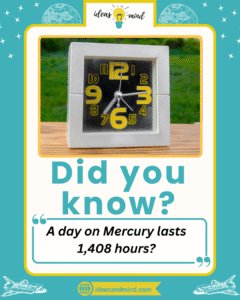
- A day on Mercury lasts 1,408 hours.
Its slow rotation results in extremely long days and nights.
- Astronauts grow taller in space.
Without gravity compressing the spine, astronauts stretch by a few centimeters.
- Stars twinkle because of Earth’s atmosphere.
Air movement bends starlight, creating the twinkling effect.
- Galaxies often collide with each other.
The Milky Way will eventually collide with the Andromeda galaxy.
- The moon controls ocean tides on Earth.
Its gravitational pull creates high and low tides.
- Earth travels around the sun at 30 km per second.
That’s fast enough to circle the entire planet in less than 24 minutes.
- Pluto is smaller than the United States.
Its total width is less than the distance from California to New York.
- The sun is 4.6 billion years old.
It is expected to continue burning for another 5 billion years.
- Space has a unique smell resembling burnt metal.
Astronauts reported this scent when removing their space suits.
Why Understanding Space Matters
Studying space, astronomy and the universe helps us:
- Understand Earth’s place in the cosmos
- Explore the possibility of life on other planets
- Learn how galaxies, stars and planets form
- Discover new scientific laws
- Recognize how fragile our planet truly is
- Advance technology and scientific innovation
Space exploration continues to expand human knowledge and shape our future.
Final Thoughts
The universe is vast, mysterious and awe-inspiring. These facts reveal only a glimpse of its complexity, beauty and power. As technology advances, we will uncover even more astonishing truths about space, time and the cosmos. The more we learn, the more we realize how little we truly know.