
Time is one of the most mysterious concepts known to science. We experience it every day, yet no one fully understands how it works. Modern physics shows that time, space, and gravity are deeply connected. The universe itself follows rules that often seem impossible to believe.
In this article, you’ll discover 20 surprising “Did You Know?” mind-bending facts about time, space-time, and the universe, based on real scientific principles and discoveries.
20 Fascinating Time & Universe Facts You Need to Know



- Time passes differently in space than on Earth.
This is a proven concept known as time dilation in Einstein’s theory of relativity.
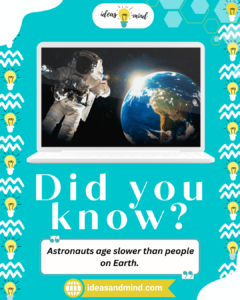
- Astronauts age slower than people on Earth.
Due to weaker gravity and high speeds, astronauts return slightly younger.
- Time moves faster on mountains than at sea level.
Higher altitude means weaker gravity, causing clocks to tick faster.
- The universe expands every second.
Space is stretching, and galaxies are moving farther apart over time.
- The speed of light is the universe’s ultimate speed limit.
Nothing can travel faster than 300,000 km per second.
- Black holes can stretch time infinitely.
Near their event horizon, time slows almost to a stop.
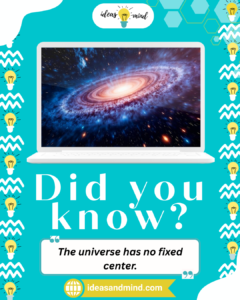
- The universe has no fixed center.
Every point in space is expanding away from every other point.
- Time travel to the future is scientifically possible.
Travelling near light speed slows your personal time.
- Billions of stars are born every hour.
Star formation happens constantly in distant galaxies.
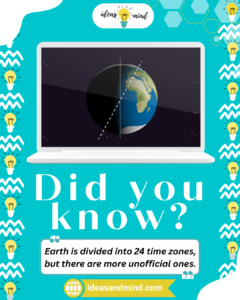
- Earth is divided into 24 time zones, but there are more unofficial ones.
Political borders and regional differences create complicated time systems.
- Your brain perceives time differently depending on emotions.
Fear slows time, excitement speeds it up.
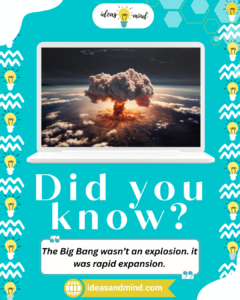
- The Big Bang wasn’t an explosion — it was rapid expansion.
Space itself expanded faster than the speed of light.
- When you look at stars, you are looking into the past.
Some starlight is millions of years old.
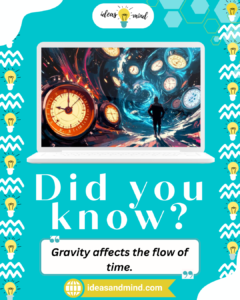
- Gravity affects the flow of time.
Stronger gravity means slower time.
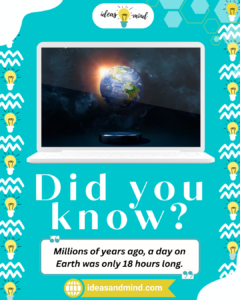
- Millions of years ago, a day on Earth was only 18 hours long.
Earth’s rotation slows by tiny increments over time.
- The observable universe is 93 billion light-years wide.
Yet scientists believe the universe is much larger, possibly infinite.
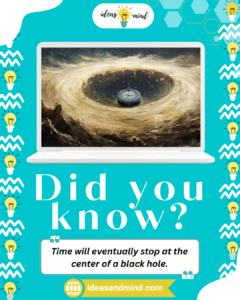
- Time will eventually stop at the center of a black hole.
Physics breaks down beyond this point.
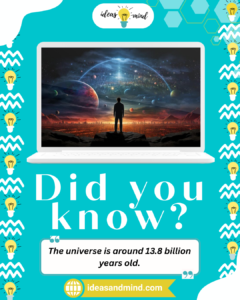
- The universe is around 13.8 billion years old.
This age is calculated using cosmic background radiation.
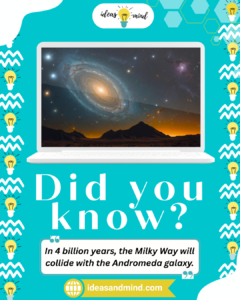
- In 4 billion years, the Milky Way will collide with the Andromeda galaxy.
The night sky will look dramatically different.
- Humans experience time differently due to memory, emotion and biology.
Time isn’t fixed, it’s influenced by the mind and the environment.
Why Understanding Time Matters
Learning about time, space-time, and the science of the universe helps you:
- Understand how physics shapes reality
- Appreciate the complexity of space and cosmic evolution
- Learn how gravity and speed influence time
- Develop curiosity and scientific thinking
- Realize how small Earth is in the cosmic scale
Time is not just a clock ticking, it is part of the fabric of the universe.
Final Thoughts
Time is one of the most fundamental yet mysterious aspects of existence. These facts highlight how modern science continues to challenge our understanding of reality. The more we study time and the universe, the more we uncover how extraordinary our world truly is.